





Imagine standing at a crossroads where one path leads to financial stability and the other to uncertainty. At this point, many people ask themselves: What is Investment and why does it matter? The answer is simple: investment is more than saving money, it is about putting your resources into something that can grow and provide future value.
So, What is Investment in practice? It means choosing assets such as stocks, property, or even art not only for their present worth but also for the income or appreciation they may bring in the future. Every smart investment moves you closer to your goals, whether that means funding education, growing your savings, or creating long-term wealth. This blog will guide you through the essentials of investment and how it can reshape your financial future.
Table of Contents
1) What is Investment?
2) How Does Investment Work?
3) Types of Investments
4) What are the Benefits of Investing?
5) Calculating Return on Investment (ROI)
6) Calculating Return on Investment (ROI)
7) What are the Differences Between Saving and Investing?
8) Conclusion
What is Investment?
Investment is the act of allocating money, time, or resources into an asset or venture with the expectation of generating a return or profit over time. Common investment forms include stocks, bonds, real estate, mutual funds, and businesses. It can also extend to alternative options such as commodities, currencies, or digital assets l
Unlike simple saving, investing involves a degree of risk, as the value of investments can fluctuate. However, it offers the potential for higher returns and long-term growth. Investment is a key strategy for building wealth, funding future goals such as retirement or education, and outpacing inflation through compounded earnings and capital appreciation.
How Does Investment Work?
Investment works by putting your money into assets that have the potential to grow in value or generate income over time. These assets can include shares, bonds, property, mutual funds, or even starting a business. When the value of the asset increases or earns interest or dividends, the investor gains a return.
The process involves balancing risk and reward. Generally, higher-risk investments offer the chance for greater returns, while lower-risk options provide more stability but smaller gains. Over time, successful investing relies on diversification, market understanding, and patience, allowing your capital to compound and grow. It helps you achieve financial goals like retirement, property purchase, or education funding.
Successful investing also hinges on a few key strategies:
1) Diversification: Spreading your money across different asset types to reduce risk.
2) Long-term Perspective: Allowing investments time to ride out market fluctuations.
3) Informed Decision-making: Understanding the markets, economic trends, and the specific assets you’re investing in.
Ultimately, investment is a tool to help you achieve financial milestones. Whether that’s buying a home, funding your child’s education, retiring comfortably, or building generational wealth. With thoughtful planning and disciplined execution, investing can turn financial goals into tangible realities.
Types of Investments
Investments come in various forms, each with different levels of risk, return, and suitability depending on an investor’s goals and risk tolerance. Below are some of the most common types: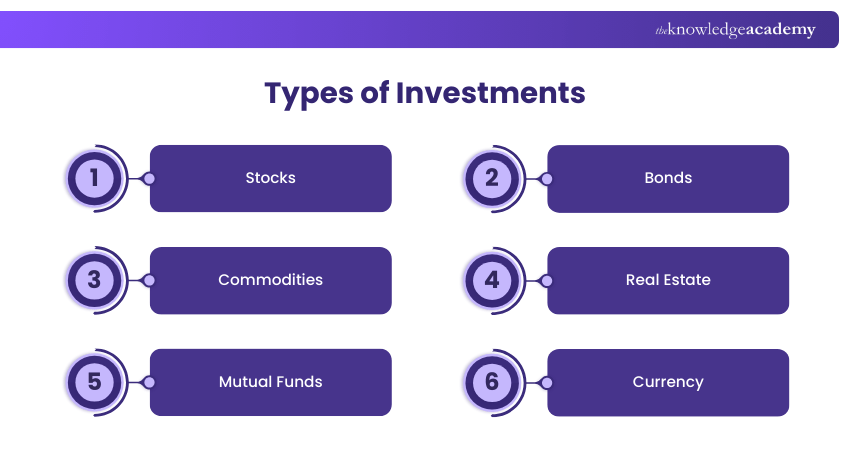
1) Stocks
Stocks, or equities, represent ownership in a company. When you buy a stock, you become a shareholder and own a small part of that business. Stocks are traded on exchanges like the New York Stock Exchange (NYSE) or London Stock Exchange (LSE), and their value can rise or fall depending on the company’s performance, economic conditions, and investor sentiment.
a) Returns can come from share price appreciation or dividends.
b) Stocks tend to offer higher growth potential but also carry higher risk due to market volatility.
Unlock the secrets of cryptocurrency trading – Join our Cryptocurrency Trading Training today and transform your future!
2) Bonds
Bonds are fixed-income securities where you lend money to a government, corporation, or other entity for a set period in exchange for regular interest payments and the return of your principal at maturity.
a) They are generally considered lower-risk investments compared to stocks.
b) Types include government bonds, corporate bonds, and municipal bonds.
c) Ideal for conservative investors seeking stable returns.
3) Commodities
Commodities are raw materials or primary agricultural products that can be traded, such as gold, oil, silver, or wheat. Investors can gain exposure through futures contracts, ETFs, or commodity-focused funds.
a) Commodity prices are driven by supply and demand, geopolitical events, and economic trends.
b) Investing in commodities can help hedge against inflation but may involve significant price volatility.
4) Real Estate
Real estate investing involves purchasing property, residential, commercial, or land, with the goal of earning rental income, capital appreciation, or both.
a) It provides tangible asset ownership and passive income potential.
b) Real Estate Investment Trusts (REITs) offer an alternative to direct property ownership with more liquidity.
c) While relatively stable, property markets can be influenced by interest rates, location, and economic shifts.
5) Mutual Funds
Mutual funds pool money from multiple investors to invest in a diversified portfolio of stocks, bonds, or other assets. They are professionally managed and ideal for those who prefer a hands-off approach.
a) They offer instant diversification, which reduces individual asset risk.
b) Investors buy shares in the fund, and returns depend on the fund’s overall performance.
c) Types include equity funds, bond funds, and balanced funds.
6) Currency
Currency investment, also known as foreign exchange (Forex or FX) trading, involves buying and selling currencies to profit from fluctuations in exchange rates. This global market operates 24/7 and is the largest and most liquid financial market in the world.
a) Investors can trade currency pairs such as USD/EUR, GBP/JPY, or AUD/CAD.
b) The goal is to speculate on whether one currency will strengthen or weaken against another.
c) Currency values are influenced by several key factors, including:
i) Interest rates set by central banks
ii) Inflation levels within a country
iii) Political stability and government performance
iv) Economic data such as GDP, employment, and trade figures
v) Monetary policies and decisions made by central banks
Drive success and learn cutting-edge revenue strategies – join our Revenue Management Training now!
What are the Benefits of Investing?
Let’s take a look at the following to understand the investment advantages:
1) Wealth Accumulation and Generation: The first and foremost reason why a person invests is to generate income and expand their pool of wealth. Obviously, the more wealth you possess, the more accessible solutions become for you. With the passage of time, you can not only increase your initial investment amount but also diversify it.
2) Enhanced Financial Objectives: When you commence investing in assets, it helps you establish your financial goals. With enough time, you can strengthen your financial goals and establish objectives to meet them.
3) Compounding: Compounding refers to an increment that happens at an exponential rate against the commodity invested. Making 2X or 4X on initial investment is what it usually boils down to. The more you invest with time, the better your chances become of making significant profit margins. 4) Creating an Inflation Shield: With time, the power of the money you hold decreases, which makes it imperative to multiply it for the unforeseeable future. With investments, you can ensure that you’ll be equipped with the right amount of money to help you through the rough phases.
4) Retirement Planning: A well-rounded investment portfolio addresses immediate financial requirements by securing your future reserves. Achieving a comfortable retirement is a common goal, yet it demands diligence and thorough research. Investing in diverse assets generates a stream of income for you and provides financial security for your loved ones. With prudent investments over time, you can ensure their well-being.
Calculating Return on Investment (ROI)
The most common method to assess an investment’s performance is by calculating its Return on Investment (ROI). This metric is computed using the formula:
How to Start Investing?
If you are still wondering how to start investing, follow the below-mentioned steps, which will explain to you more in detail about how to create an investment portfolio: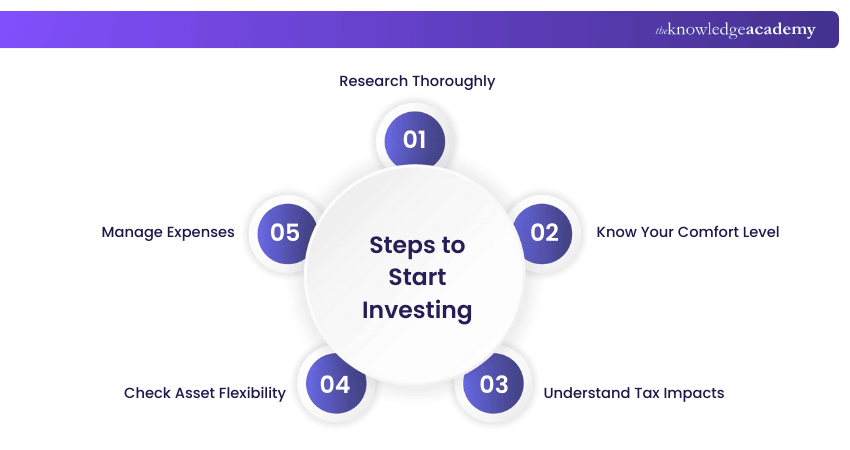
a) Research: It should be your first step before you start investing in assets. A sound knowledge of the concept of investment, types of investment, assets that you can invest in, risk factors, etc., is necessary for you to know. Before buying a single share of a company, understand the company’s future and then buy the share.
b) Plan Your Spending: Decide why you are putting your money away and how to ensure that monthly expenses do not interfere with your emergency fund. Before investing, make sure that it does not interfere with your lifestyle.
c) Study About Liquidity Restrictions: Some investments may be locked in for quite some time and cannot be liquidated, that is, sold at any time you want. Before you invest, learn if they can be sold or bought at any time.
d) Taxes: are the most important part of your financial journey. It would be best if you always researched tax implications. You need to formulate strategies that can extend beyond what the product can hold and the tax vehicle they invest in.
e) Risk: Decide on how much you are ready to risk. You need to be comfortable with how your financial power will allow you to take risks. Strategies are ways in which you can reduce risks and explore ways to mitigate any risks.
What are the Differences Between Saving and Investing?
Comprehending the distinction between saving and investing is crucial for effective financial planning. Let’s explore the key differences between these two financial strategies: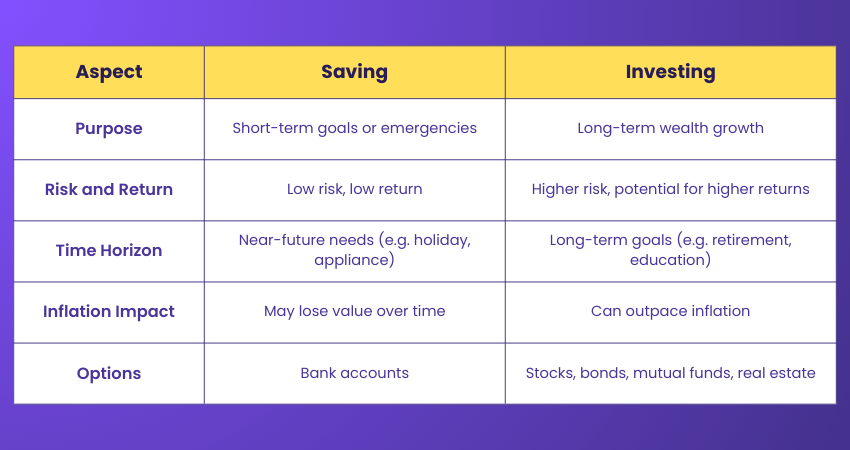
Saving and investing are both essential financial strategies but serve different purposes. Saving is best for short-term goals or emergencies, offering low risk and easy access through options like bank accounts or fixed deposits. However, the returns are minimal and may not keep up with inflation.
In contrast, investing is aimed at long-term wealth growth through assets like stocks, bonds, or real estate. While it carries higher risk, it also offers the potential for higher returns and can outpace inflation over time.
In simple terms, saving protects your money, while investing helps it grow. A smart financial plan often includes both saving for immediate needs and investing to build a secure future.